


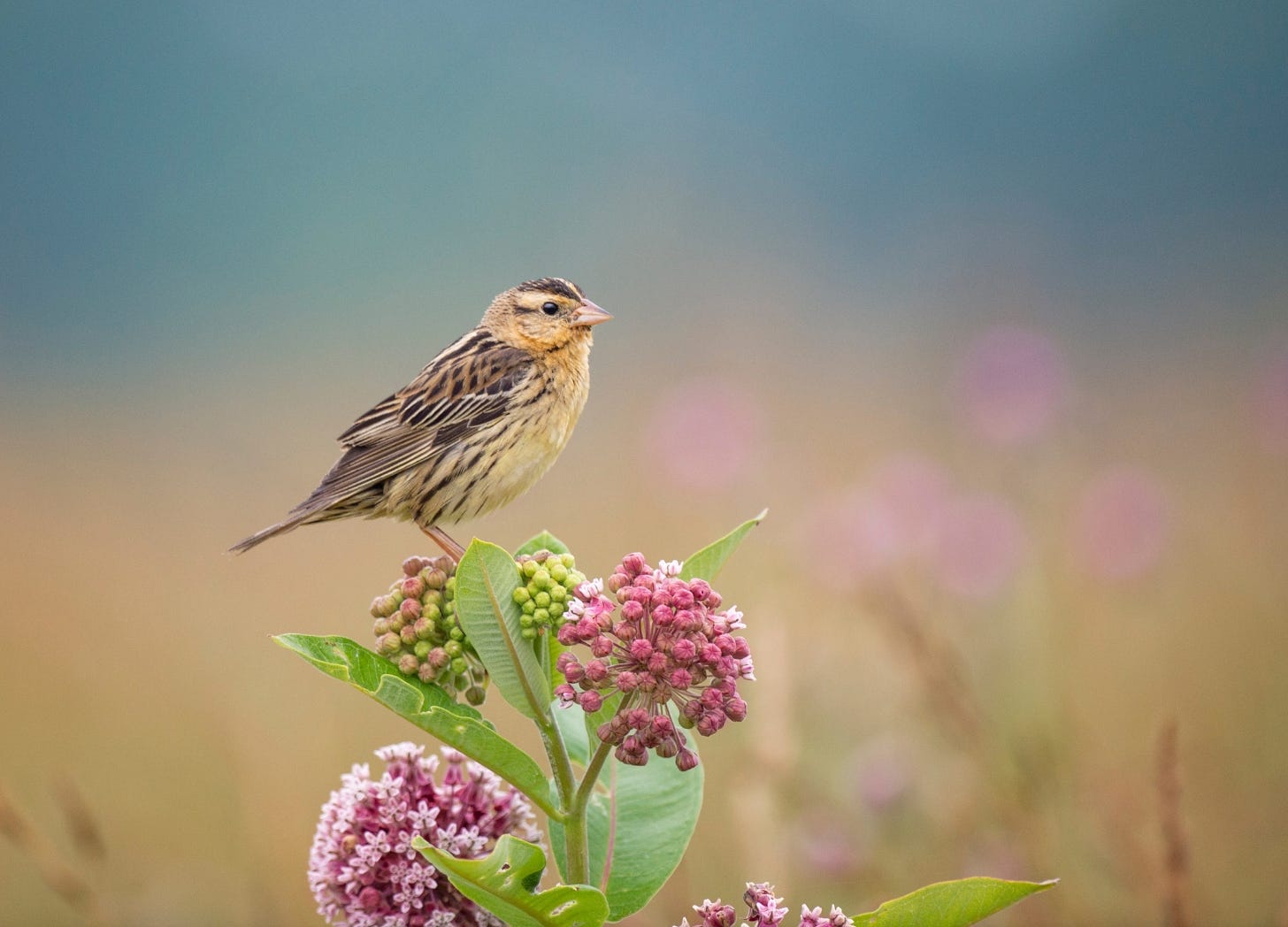
The Court of Quebec has fined the Ville de Longueuil $30,000 for violating the Species at Risk Act, after destroying at least one Bobolink nest.
The Bobolink (Dolichonyx oryzivorus) is a medium sized songbird in the blackbird family. Breeding males have distinct plumage: mostly black with a white back and yellow nape, they look like they are wearing backwards tuxedos. Females are buffy brown with dark streaking, plumage that helps them camouflage while nesting. Bobolinks nest on the ground in grasslands — habitat that is shrinking due to agriculture, overgrazing, and development.
“Although grasslands are important for our climate, as a carbon sink, and for biodiversity, they are among the most endangered and least formally protected ecosystems on the planet,” says Andrew Coughlan, Associate Director for Québec and the Atlantic at Birds Canada.
More than 25% of the world’s Bobolink population breeds in Canada, where the species is listed as Threatened under Schedule 1 of the Species at Risk Act. It is also protected by the Migratory Bird Convention Act.
“The species has suffered severe population declines since the early 1980s,” explains Coughlan, “And the declines have continued in recent years, particularly in Eastern Canada, where the bulk of the Canadian breeding population occurs.”
Although Bobolinks are typically associated with hayfields, they will nest anywhere with suitable grassy areas — which leaves them vulnerable to mowing. What happened in the Ville de Longueuil serves as a stark example: In July 2024, an individual reported witnessing city staff mow over a bobolink nesting site at Parc des Sorbiers. Enforcement officers subsequently launched an investigation, which determined that the Ville de Longueuil was indeed responsible for damaging or destroying at least one bobolink nest. The municipality pleaded guilty to one count of violating the Species at Risk Act.
Coughlan says the ruling highlights the fact that Bobolinks are protected by law in Canada, and there are real consequences if they are harmed.
“It also shows municipalities and landowners that citizens are concerned about and are willing to act as sentinels for local birds and nature,” he adds.
The Ville de Longueuil has indicated that it has already modified its maintenance routine for certain areas, delaying mowing until after July 15 — when the Bobolink is finished nesting. This is one of the measures recommended in the proposed Bobolink Recovery Strategy.
“This is a great step towards protecting this species during the nesting season,” says Coughlan.
Other measures could include training staff to identify nest habitats and conducting ecological surveys in green spaces. If a late active nest is discovered, staff should leave a buffer zone of at least 10 meters around the nest.
While this ruling is a win for the Bobolink, agricultural practices continue to threaten many grassland species. Mowing hayfields before nesting is complete, overgrazing, and pesticide use need to be addressed. Saving Bobolinks will require conserving grasslands and educating farmers to delay mowing, use rotational grazing, and avoid pesticide use. These practices can be encouraged through stewardship programs that offer financial incentives for preserving habitat.
For now, the fine serves as a precedent and will hopefully encourage other landowners to ensure that routine activities, such as mowing, include measures to protect vulnerable grassland species like the Bobolink.