


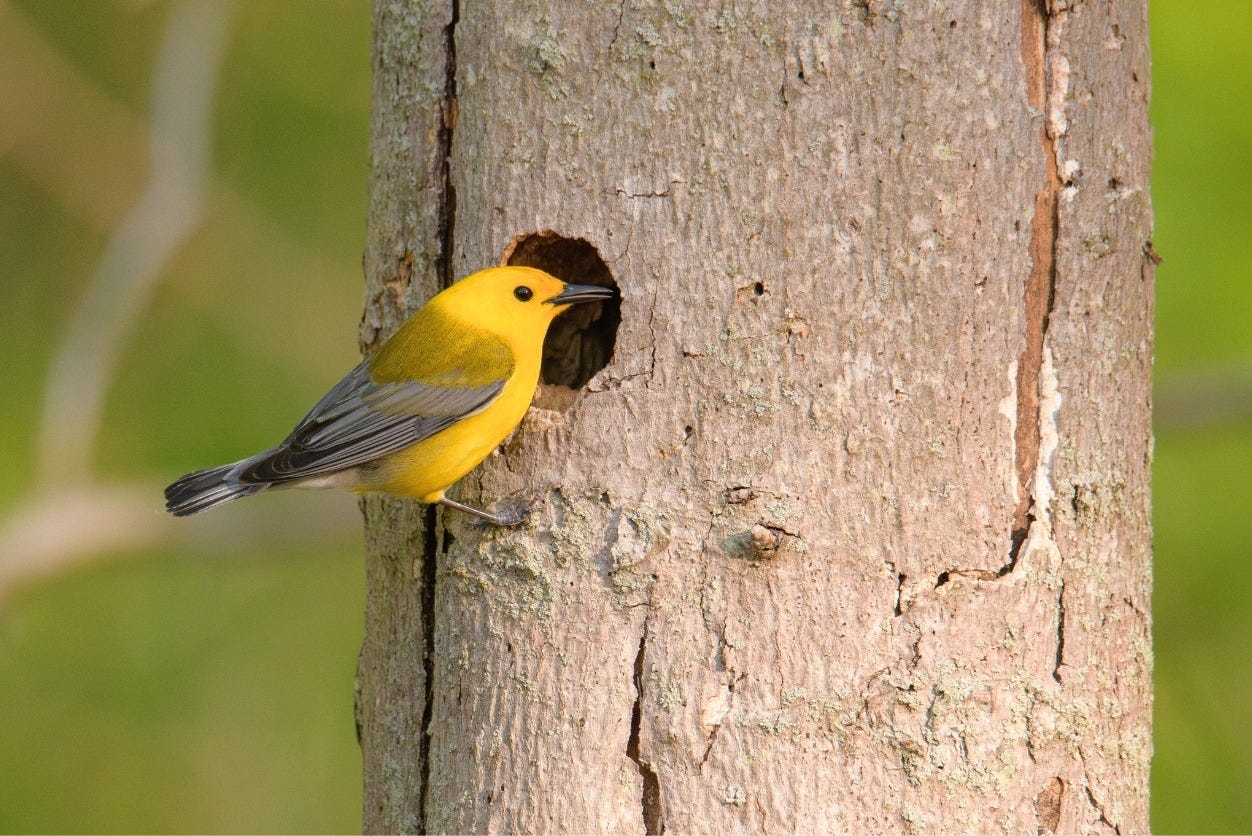
As you may know by now, I’m a bird lover. So I’m always happy when one of the stories I find has to do with bird conservation. Even better, when it features a bird I have photographed. This feature image is a male Prothonotary Warbler at his nest at Point Pelee National Park in Ontario. This is one of the only nesting sites for this endangered species — which is one of the only warblers (besides the Lucy’s Warbler) that nests in tree cavities. It’s perhaps my favourite species, and I was thrilled to visit the park in 2023 at a time when this pair had established their nest. This good dad was bringing insects to his partner and paused a few seconds before flying off to hunt some more. What a moment to witness, capture, and finally share with you.
Why this photo? The first story I’m featuring is about a man in Ontario who has devoted more than 40 years to building and monitoring nest boxes — including those for Prothonotary Warblers. Being that I’m a birder and from Ontario, I was surprised I hadn’t heard about him before — and amazed by how he has singlehandedly helped these birds rebound. In these tragic times, it warms my heart to know that there are kind souls like this who are selflessly doing their part for nature. And now I’m inspired to put up my own nest boxes this spring.
I hope this issue brings you some hope and inspiration as well. As poet poet Emily Dickinson said, hope is the thing with feathers.
Ontario man receives Governor General’s award for bird conservation
In Haldimand, Ontario, Don Wills has been awarded a prestigious Meritorious Service Decoration from the Governor General of Canada for helping two endangered bird species. For the last 40 years, Wills has built and maintained more than 500 Eastern Bluebird nest boxes along a trail spanning 50 miles. In 1997 he set out to help Prothonotary Warblers, when there were only 10 pairs remaining in Canada. Because this species only nests in natural tree cavities made by chickadees or woodpeckers, he designed a nest box that mimics a hollowed-out tree trunk. He set these up in swamp forests near Long Point, to great success. Wills has tracked — and been responsible for — over 20,00 bluebird hatchlings, and 436 baby warblers.
MGM Resorts hits solar milestone in Las Vegas
MGM Resorts International has achieved a major sustainability milestone by powering up to 100% of its daytime electricity needs on the Las Vegas Strip. In December 2025, the company began receiving 115 MW of solar energy and 400 megawatt-hours (MWh) of battery storage from the newly operational Escape Solar and Storage Project located in Lincoln County, Nevada. Paired with its existing Mega Solar Array, the system delivers 115 MW of clean power and 400 MWh of storage, allowing the company to capture peak solar energy and use it beyond daylight hours. The project brings MGM closer to its goal of 100% renewable energy across U.S. operations by 2030.
Fully electric car ferry begins service in arctic Norway
In Norway’s far north, the new M/F Vargsund has commenced regular service as the world’s northernmost fully electric car ferry, operating reliably even in temperatures down to −25 °C. The 50-meter battery-powered vessel carries cars and passengers between islands in Finnmark and demonstrates the viability of zero-emission maritime transport in extreme climates, as part of broader efforts to electrify ferry routes and reduce carbon footprints in northern Europe’s transport sector.
Nearly 500 acres along Myakka River secured for conservation
A substantial 497 acres of privately owned land along Florida’s Myakka River have been permanently preserved for environmental conservation, ensuring the protection of habitat, water quality, and wildlife corridors. The conservation effort, led by local land steward Steve Herrig, designates two distinct parcels, the Wooded Trail Preserve and North Woods Preserve. They will be maintained in their natural state and free from future commercial or residential development.
AI tech enhances sustainable seafood monitoring
New AI-driven monitoring systems are being deployed on fishing vessels to support sustainable seafood verification in real time. The current monitoring system uses cameras, GPS trackers, and sensors on board ships to record fishing activity onto a hard drive — resulting in hours of footage that needs to be manually reviewed when a vessel returns to port. Now, AI modules can review and analyze footage in real time to detect fishing activity, identify species, flag illegal catches, and cross-check catch reports.