


Hello friends,
This is the final good news roundup of 2025! That’s 180 stories of conservation and climate solutions this year — and I just got started in April. This has been an awesome journey, and thank you so much for sticking with me.
I’d love your feedback. Whether you just subscribed or have been with me since the beginning, I want to know if if any particular stories stood out for you. I’m compiling a list of the year’s best Good News stories, and I want your take! You can reply to this email, or join my chat (link below) to chime in. I can’t wait to see what everyone has to say!

Flat-headed cat rediscovered in Thailand
Thailand’s Department of National Parks, Wildlife and Plant Conservation (DNP) and Panthera Thailand have confirmed sightings of the rare Flat-headed Cat (Prionailurus planiceps). One of world’s rarest wild felines, the Flat-headed Cat was last seen in 1995, and was feared extinct. Camera traps in the Princess Sirindhorn Wildlife Sanctuary in southern Thailand recorded repeated sightings in 2024 and 2025 — including a female with a cub — proving the species is not only present but breeding in the wild. This discovery highlights the success of long‑term habitat protection and monitoring.
West Hollywood bans pet sales
West Hollywood, California, has passed the most comprehensive ban on retail pet sales in the United States, prohibiting the sale of mammals, birds, reptiles, amphibians, arachnids, hermit crabs, and fish starting May 2026. Expanding on a 2010 ban on dog and cat sales, the new ordinance addresses the cruel conditions of commercial breeding operations, deceptive marketing of wild or exotic pets, and public health risks from zoonotic diseases. By promoting shelter adoption and responsible ownership, the city aims to reduce animal suffering, limit the exotic pet trade’s ecological impact, and serve as a model for other municipalities. The unanimous council vote reflects broad community and animal welfare support.
Researchers in China using AI for dolphin conservation
Given the carbon footprint of AI, I usually decline to promote stories about is use for conservation and climate — but this application is having tangible benefits for dolphin conservation. In Xiamen Bay, China, researchers have deployed an AI-powered conservation system that identifies individual Chinese White Dolphins (Sousa chinensis) using unique dorsal fin markings. The system has tracked 13 dolphins with 90% accuracy, and alerts authorities instantly to vessels entering restricted areas — improving enforcement response times by 65%. It also saves researchers the long and tedious task of sifting through thousands of images and video so they can focus on science and conservation instead of paperwork.
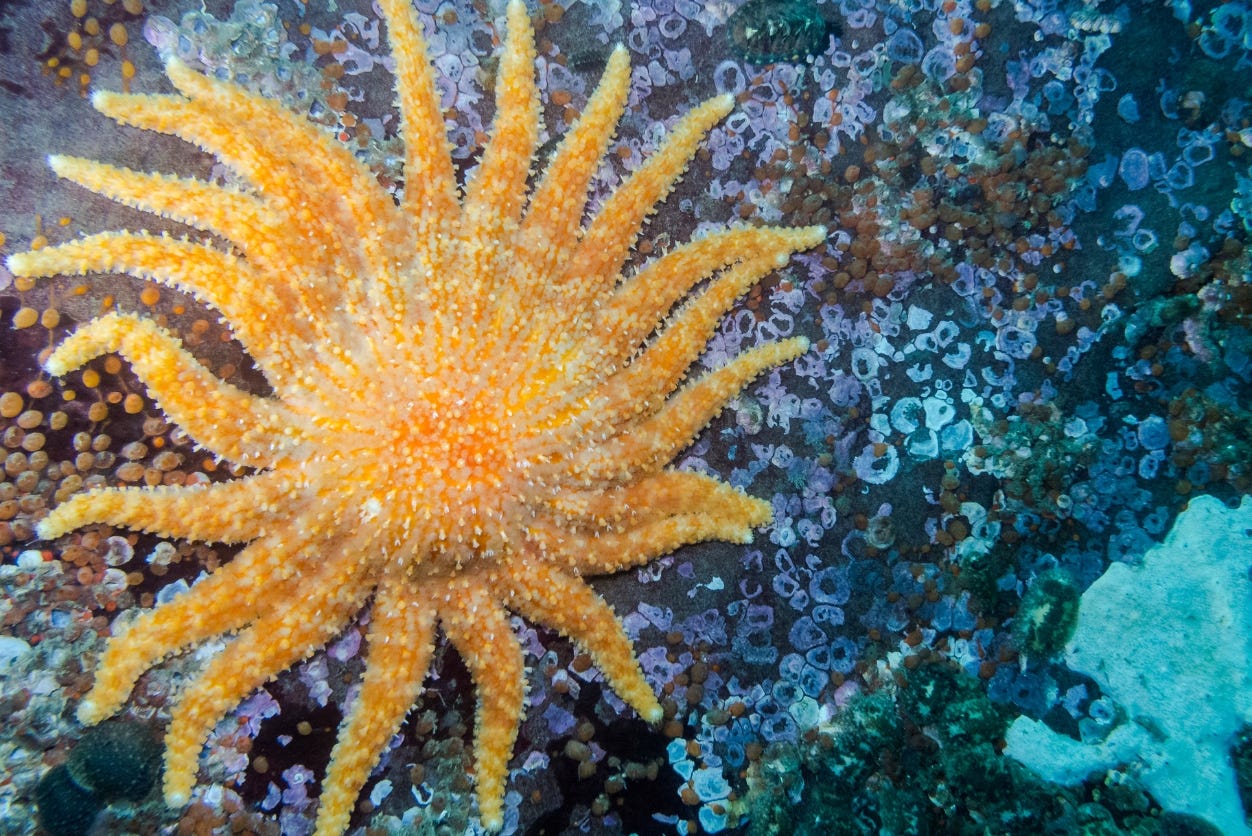
Sunflower Stars reintroduced in California
Scientists and conservation groups in California have successfully restored the once‑abundant Sunflower Star (Pycnopodia helianthoides) — one of the world’s largest sea stars, which was nearly wiped out by disease in the mid‑2010s. Divers released dozens of captive‑bred juveniles into Monterey Bay, where preliminary monitoring shows high survival and no signs of disease. Sunflower Stars are important predators of Sea Urchins, which have decimated kelp forests in their absence. By reintroducing this keystone predator, scientists hope to help rebalanced the Pacific coastal ecosystem.
Scientists develop a way to remove forever chemicals
Researchers at Rice University have created a groundbreaking technology that rapidly captures and destroys PFAS, the persistent “forever chemicals” contaminating water worldwide. Using a layered double hydroxide (LDH) material made of copper and aluminum, the system traps PFAS hundreds to thousands of times faster than current methods and safely breaks them down, with the material regenerating for repeated use. Tested in river water, tap water, and wastewater, this approach promises a sustainable, highly efficient solution to one of the world’s most stubborn pollution problems.