


Hello Friends,
This was a tough week to publish positive news. I had planned on sharing five positive outcomes from COP30, but after it concluded without a roadmap for phasing out fossil fuels, I didn’t want to gloss over the disappointment that many of us are feeling. Then Canada’s federal government announced an agreement with Alberta to build a new pipeline — which flies in the face of our net-zero goals, risks oil spills, and railroads over Indigenous rights. I hesitated to showcase good news when everything seems to be going wrong.
But this is precisely why I should.
When environmental catastrophes and climate backpedaling dominate the headlines, it can seem like we’re doomed. Like many people, I tend to turn inward and shut down. But if you dig a bit deeper, you’ll find the good stuff: species making a comeback, innovations in renewable energy and waste reduction, and land being protected and restored. And behind that work is a network of passionate, brilliant, and kind souls who are dedicating their time and talent to protecting the planet.
Every week that I put this newsletter together, I feel uplifted. When I’m feeling the most cynical and depressed, these stories remind me that all is not lost. And I know I’m not alone. So read on, and know that there are good people in the world — and you are one of them.
Columbia and the Netherlands to host conference on phasing out fossil fuels
After COP30 in Belem, Brazil concluded without a plan to phase out fossil fuels, Colombia and the Netherlands announced they will co-host the First International Conference on the Just Transition Away from Fossil Fuels. Scheduled for April 28 & 29, 2026, the conference will take place in the port city of Santa Marta, Columbia — a major hub for coal exports. This landmark summit will unite voices from around the world to forge a fair and actionable roadmap for ending fossil fuel dependency and transitioning to sustainable, diversified, and accessible energy.
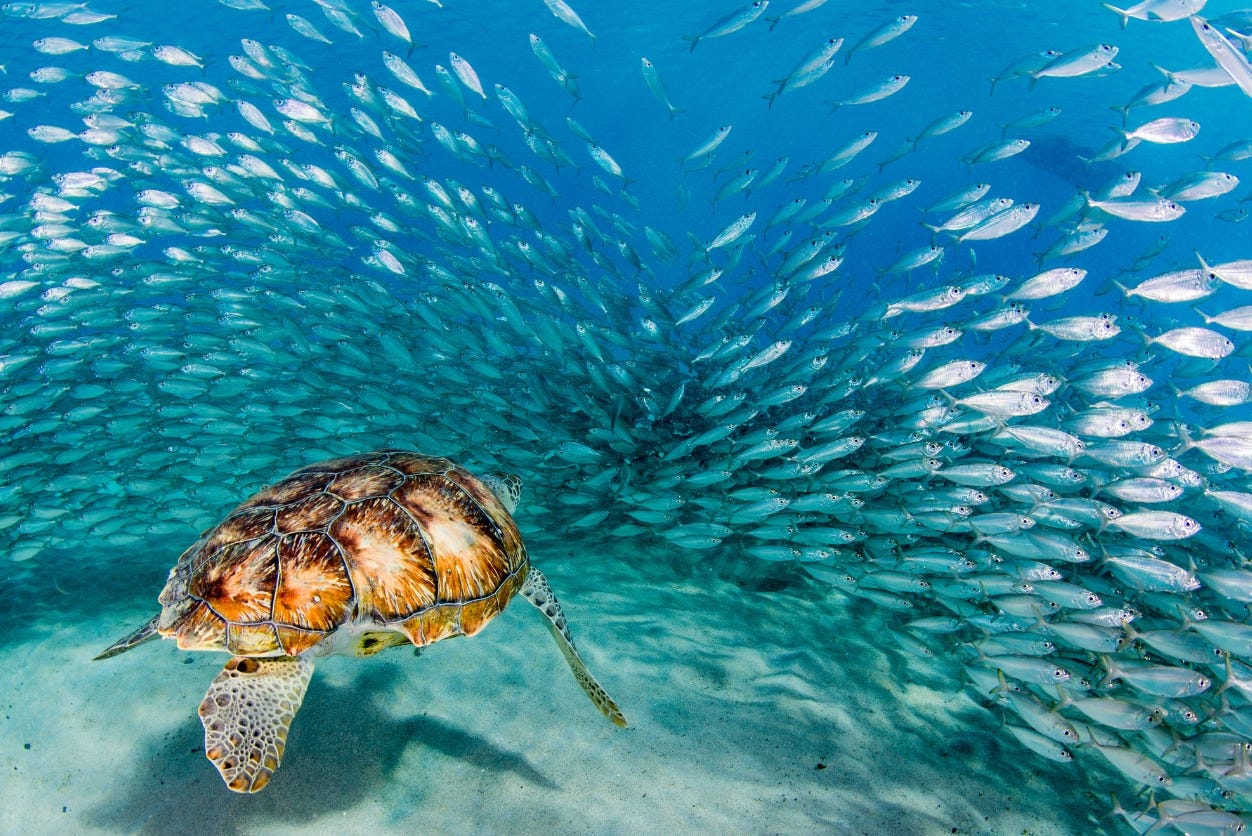
Solar-lit fishing nets cut sea turtle bycatch by 63%
Researchers have developed solar-powered LED buoys that attach to gill nets. In field trials off Mexico’s Gulf of California, nets equipped with these buoys cut accidental sea-turtle bycatch by 63%. The green flashing lights make the nets more visible underwater to sea turtles (while not deterring target fish like yellowtail), and the devices recharge in sunlight and can run for more than five days, avoiding the waste and inconvenience of battery-powered lights or single-use glow sticks. Developed collaboratively by scientists and local fishers, the innovation appears to offer a practical, low-cost way to reduce turtle mortality while keeping fishing yields steady.
U.S. federal judge has reinstated a fishing ban in a protected Pacific marine area
A U.S. federal judge has reinstated the ban on commercial fishing in the Pacific Islands Heritage Marine National Monument — a huge protected marine area around remote islands and atolls southwest of Hawai‘i — ruling that a recent attempt by the federal government to reopen the waters to industrial fishing violated legal procedures. The decision blocks fishing between 50 and 200 nautical miles around Johnston Atoll, Jarvis Island and Wake Island, overturning a 2025 government letter that had permitted commercial fishing in those waters. Environmental and Indigenous groups had challenged the reopening, arguing it threatened one of the planet’s most pristine marine ecosystems. The ruling is widely seen as a major win for ocean conservation and legal protections of biodiversity in one of the world’s last largely untouched marine wildernesses.
Tennessee plans to reintroduce threatened woodpecker
More than 30 years after the Red‑cockaded Woodpecker was last seen in Tennessee, state and federal agencies have unveiled a plan to reintroduce the species by 2028 — restoring about 1,200 acres of mature pine-forest habitat in the Savage Gulf State Natural Area. Once widespread across the Southeast, the woodpecker declined drastically due to wildfire suppression and the logging of old-growth pine forests. The restoration effort will involve controlled burns and removal of invasive mid-story trees. If successful, about ten breeding pairs will be reintroduced, making Tennessee the 12th U.S. state to host viable woodpecker populations. By rejuvenating the pine-forest ecosystem, many other species will benefit as well.
Canada and the Haida Nation have established new marine refuges
The Canadian government and the Council of the Haida Nation have established two new marine refuges off the coast of Haida Gwaii, B.C. G̱aw Ḵáahlii Marine Refuge and X̲aana K̲aahlii Marine Refuge cover about 29.6 km² in total, protecting critical habitats for salmon, herring, seabirds, harbour seals and other marine life. Co-managed by the Haida Nation and Fisheries and Oceans Canada, the move builds on nearly two decades of Indigenous-led marine planning and advances Canada’s broader goal of safeguarding 30% of its marine and coastal areas by 2030. Most importantly, the designation supports biodiversity, cultural and food-security values for the Haida community while protecting globally significant ecosystems for future generations.
I’m so pleased to have found your newsletter Brett. Thank you for these glimmers of hope.
Thank you so much Emily! I really needed to hear that — I saw your note right after someone else unsubscribed. I guess we can't be everything to everyone, but as long as it connects with somebody like you, it is totally worth doing!